

The Wargul and the Swan River. An original work created by artist Lily Wilson, a Binjarrup Noongar woman to mark the site of the Swan-Canning Shellfish Reef Restoration Project. © Lily Wilson

For emerging Aboriginal artist Lily Wilson, art has never been separate from place. Rivers, estuaries and Sea Country are not just landscapes she paints – they are living archives of family, culture and care. That deep connection comes into focus in her latest work: a vivid painting created as a sign marking the completion of The Nature Conservancy’s latest shellfish reef restoration project in Perth’s Swan Canning estuary.
Wilson, a Binjarrup Noongar woman with family connections to Whadjuk country, is currently studying a Bachelor of Creative Arts at Curtin University, majoring in Fine Arts. Until recently, her work lived mostly at home, shared quietly with family. “I’ve only really started focusing properly on my art in the last year,” she says. “I spent pretty much every night painting or drawing, and then I applied to uni – and it’s really opened my world.”
Creativity runs deep in Lily’s family, and she is proudly continuing a strong intergenerational artistic lineage where art functions as cultural memory, storytelling and care. She grew up surrounded by culture and expression, watching her two grandmothers carve lino, crochet, do watercolours and create, and the guidance and artistic approach of those closest to her have shaped her deeply.
Her grandmother Laurel Nannup (affectionately known as “Lolo” to Lily) is a highly respected Noongar Elder, printmaker, and sculptor, widely regarded as one of Western Australia’s most important artists. Her deeply personal works that tell the lived history of Noongar people and the Stolen Generations, and her son Brett Nannup, Lily’s father, has built his own reputation as a benchmark for culturally grounded storytelling in public spaces. Lily’s other grandmother loved making leadlight panels and painting boats, the river and her beloved cats, and her mother, Mandy Wilson, is a respected published writer and anthropologist whose work centres listening, responsibility and the power of lived experience.
Those early memories - sneaking into a shed to look at her nana’s paintings, walking along the river with her Lolo - form an emotional backbone to her practice today and a platform from which her own voice, curiosity and way of seeing the world are quietly and confidently emerging.

The painting created for the Swan-Canning project is titled The Wargul and the Swan River. At its heart is the Wargul – the rainbow serpent and protector of the river – surrounded by brightly coloured aquatic life.
“I wanted to show the Wargul as a protector,” she explains. “Especially with the shellfish reefs coming back, cleaning the water and creating homes for other species. It felt really important to tell that story visually.”
Colour is central to her storytelling and Lily is unapologetically drawn to bright palettes, which she sees as both joyful and inviting. “The Wargul is rainbow, and it represents life,” she says. “Even though the river can be murky now, I wanted to show how it can be healthy again. Colour pulls people in.”
That sense of optimism is tied closely to the reef restoration itself, an initiative led by The Nature Conservancy (TNC) in partnership with DBCA, with support from the Minderoo Foundation, Lotterywest and several prominent Western Australian philanthropists. The project, which saw the construction of 24 individual shellfish reefs across 6 hectares in the lower Swan Canning Estuary, is now complete and fully functioning.
Lily speaks passionately about the role shellfish play as filter feeders and habitat builders, and about the sadness of knowing how much was lost. Creating the artwork allowed her to contribute in her own way. “I’m not a marine biologist,” she says, “but this was a way to be part of something really important.”
Looking ahead, Lily’s ambitions are expansive. Already on her path to a career practising art, she also expresses a desire to work closely with people and mentions the idea of art therapy as one important way to collaborate with communities, particularly in spaces where creativity is less accessible. Like her Elders, she hopes her art can be a form of truth-telling, connection and care.
“I don’t want to do just one thing,” she says. “I want to keep experimenting. And I want my art to mean something – for me, and for the people who see it.”
In a project rooted in restoration, Lily’s work stands as a message: that culture, environment and future are deeply intertwined, and that healing can be expressed as vividly on a canvas as it is beneath the water’s surface.
The sign is located at the path to Point Walter Dog Beach: https://maps.app.goo.gl/1zbmNDUGCuxMVHvF7
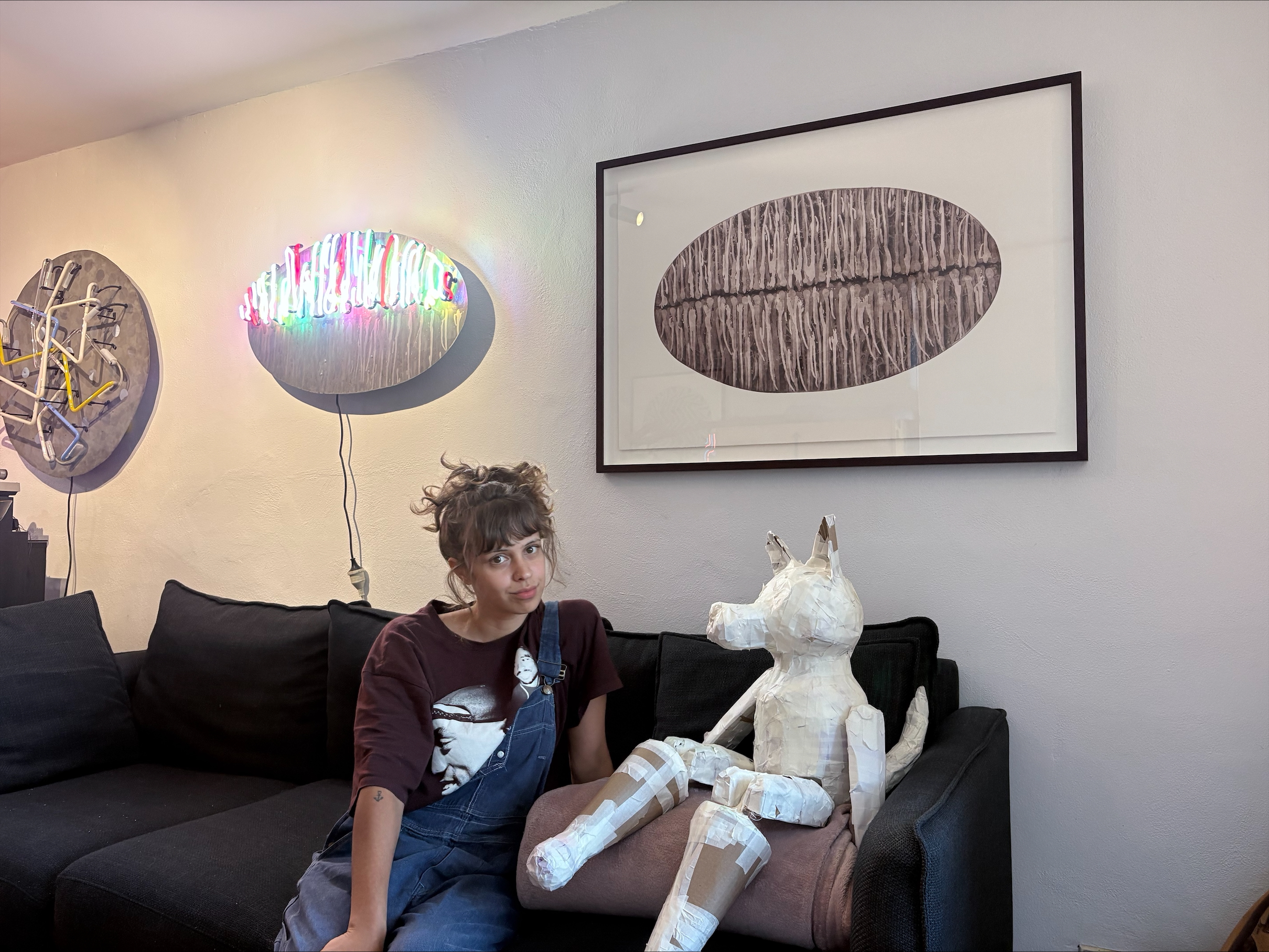
Artist Biography
Lily Wilson is a young Binjarrup Noongar woman from Whadjuk Noongar Country whose presence reflects a strong intergenerational lineage of storytelling, cultural care and connection to place. Raised within a family where art, research and lived experience are deeply valued as forms of knowledge, Lily’s perspective has been shaped by close relationships to Country, memory and community.
She is the daughter of Noongar artist Brett Nannup and writer and anthropologist Mandy Wilson, and the granddaughter of highly respected Noongar Elder and artist Laurel Nannup. While still early in her own journey, Lily’s voice sits naturally within this continuum, grounded in listening, observation and respect for those who came before her, and attentive to how stories are carried forward into the future.