


Reef Builder: Restoring Australia's lost shellfish reefs
Restoring shellfish ecosystems in the Swan-Canning Estuary
A Reef Builder project
The Swan-Canning Estuary lies at the heart of Perth as its two rivers meet and flow onward to the ocean at Fremantle. The Swan River, also known as the Derbarl Yerrigan, it is a place of deep spiritual and mythological significance to south-west Western Australia’s Traditional Owners, the Noongar people. For thousands of years this area has been vitally important as a source of food, water, transport and recreation.
The area is home to diverse wildlife:
- Over 130 species of fish including bull sharks, rays, catfish, herring, pilchard, bream, flatheads, leatherjackets and blowfish.
- Seahorses coexisting with jellyfish, anemones, seagrass, prawns and crabs.
- Resident population of around 20 Indo-Pacific Bottlenose Dolphins.
- More than 80 bird species including the eponymous Black Swan, Silver Gull, Twenty-eight Parrot, Australian Pelican, Forest Red-tailed Black Cockatoo, Australasian Darter and Sacred Kingfisher, as well as many cormorants (locally referred to as 'shags'), herons, egrets, grebes and ducks.
- Small mammals like the Water Rat, Brushtail Possum and Quenda.
The history of shellfish in the Swan-Canning
The story of shellfish in the Swan-Canning Estuary is rich and complex. The estuary would naturally be fresh-brackish (semi salty), but has be altered into a marine-brackish sytem following the removal of the limestone bar at Fremantle heads in 1900. At this time, sub-fossil oyster shells, from a thriving population some 10,000 years ago, dominated the bottom waters. In the early 1900’s up until the 1970’s, they were systematically dredged to provide the mortar to build Perth and the surrounding areas.
When the estuary was permanently opened to allow passage to Perth and the construction of a permanent port at Fremantle, mussels moved in and formed large beds on the sea beds. Over exploitation and pollution issues have led to the loss of all critical shellfish material in the estuary and left the bottom in a barren state, supporting a low diversity of fish and invertebrate species.
The Swan-Canning Shellfish Restoration Project
With the loss of these diverse ecosytem types , the health of the estuary is at risk, but we have been working to restore these ecosystems since 2019 with amazing support from Lotterywest, The Minderoo Foundation, the WA State Government (DBCA) and the Australian Government as part of the highly successful Reef Builder program.
Thanks also go to some of Western Australia’s most respected companies and philanthropists including Jock Clough, Adrian & Michela Fini, Austral Fisheries, Gavin Bunning, The McCusker Foundation, Major Holdings Pty Ltd, James & Marion Taylor, and Michael & Margrete Chaney.
A vision for the Swan-Canning Estuary
In December 2022, The Nature Conservancy completed construction of 24 individual shellfish reefs across 6 hectares in the lower Swan-Canning Estuary at four locations, namely Attadale, two locations in Freshwater Bay, and Point Walter. These shellfish reefs are amongst the largest built by TNC in Australia in terms of both area and height, with peaks at Point Walter reaching 2 m above the estuary bed.
The reefs were seeded with adult Blue mussels (Mytilus galloprovincialis) over a
3-month period from October 2022 to January 2023. In total, 160 tonnes of adult mussel stock, comprising approximately 6 million individuals, were seeded onto the reef bases. Preliminary assessments just after seeding showed that the mussels quickly formed strong attachments to each other and the reef bases.

The Project in Numbers
A snapshot of the Swan-Canning Reef Restoration Project in numbers. Download now.
The reefs are coming back to life
Monitoring in the first year after construction found that around 10% of the seeded blue mussels remained on the reefs, which was within expectations for large‑scale restoration projects. Over time, mussel numbers continued to decline and did not reach levels needed to form a self‑sustaining mussel reef.
However, the reefs delivered a very positive and unexpected outcome. By 2024 and continuing through to the final monitoring in 2025, the reefs supported strong natural settlement of other native shellfish, particularly spiny scallops and Australian flat oysters. Flat oysters were recorded at an average of around 93 individuals per square metre of reef, with especially high numbers at Attadale and Freshwater Bay. These oysters represent the most northerly known population of Australian flat oysters in Western Australia.
The reefs also quickly became productive underwater habitats. Fish abundance and biomass increased dramatically after reef construction, in some places by thousands of percent compared to pre‑restoration conditions, and remained far higher than nearby bare seabed through to 2025. Overall species diversity was consistently greater on the reefs, with a wide range of fish, invertebrates and other marine life using them for shelter and feeding.
While the original goal of restoring blue mussel reefs was not fully achieved, the project clearly demonstrated that reintroducing reef structure to the Swan‑Canning Estuary can drive substantial ecological recovery. By the end of monitoring, the reefs were functioning as diverse, living ecosystems and have provided valuable insights to guide future shellfish reef restoration in the estuary and elsewhere.
For a concise summary of the project and its outcomes, please see the Swan‑Canning Shellfish Reef Restoration project summary.
If you’d like to experience the project in person, you can visit our project signage at Point Walter Dog Beach, which shares the story of reef restoration in the estuary and features artwork created especially for the site.
For more information on the achievements of the Reef Builder initiative, read the 2024 Reef Builder Final Summary Report.
Read more:
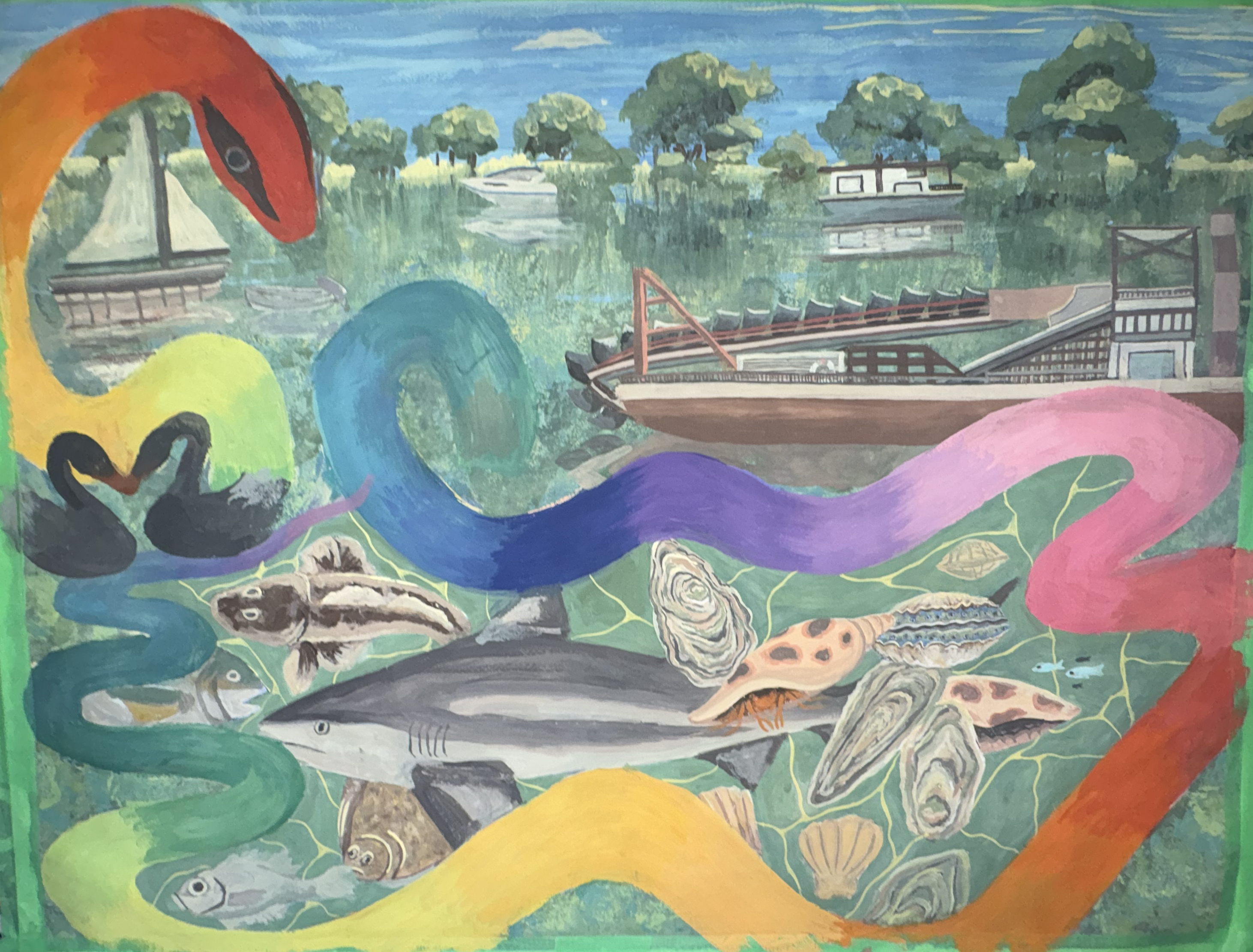
Meet the artist: Lily Wilson
The Wargul and the Swan River
For emerging Aboriginal artist Lily Wilson, art has never been separate from place. Rivers, estuaries and Sea Country are not just landscapes she paints – they are living archives of family, culture and care. That deep connection comes into focus in her latest work: a vivid painting created as a sign marking the completion of The Nature Conservancy’s latest shellfish reef restoration project in Perth’s Swan Canning estuary.
The painting created for the Swan-Canning project is titled The Wargul and the Swan River. At its heart is the Wargul – the rainbow serpent and protector of the river – surrounded by brightly coloured aquatic life.
Read more about Lily, her story and the inspiration for The Wargul and the Swan River.