


How have we helped Giant Kelp?
Under the surface of Tasmania’s vast ocean waters, Giant Kelp Macrocystis pyrifera once flourished. These magnificent giants once swayed in vast numbers with the ocean’s currents, flickering gold in the sunlight and skimming along the water’s surface. These trees of the seas can reach up to 40 metres tall and grow at a rapid rate of 50cm a day in the right conditions. However, the once thriving Giant Kelp forests have slowly disappeared, declining by over 95% in Tasmania since the 1970s.
A once vibrant and healthy ecosystem has been impacted by increasingly frequent heatwaves driven by climate change and a strengthening East Australian Current that is driving warm, nutrient-poor water further south. This has meant Giant Kelp has now also suffered in competition alongside other more warm-tolerant seaweed growth taking over.
Where there is kelp there is marine life, and while Sea Urchins are important herbivores in healthy kelp forest habitats, recent explosions in urchin populations have led to overgrazing which has dramatically reduced the extent of kelp forests, not just in Tasmania – but at a global scale.
The restoration of Giant Kelp is crucial to increasing habitat for many of Tasmania’s marine species. A thriving forest improves the health of the coastal ecosystem. Kelp forests can also support a range of incredible biological diversity, including marine invertebrates, fish, mammals and birds. As it grows, Giant Kelp creates complex and productive underwater forests that provide a wide range of ecosystem services, from habitat for commercially valuable species like lobsters, scalefish and abalone, to improving local water quality, buffering coastlines from erosion.
Restoring Giant Kelp forests will also help recreational user groups, like local dive operators (healthy underwater forests are literally huge dive tourism attractions), and commercial fisheries by supporting job creation in regional coastal areas to supplement the developing urchin fishery as a current control method to allow for kelp recovery.

Getting by with a little ‘kelp’ from our friends
We understand the importance and the urgency of reforestation underwater in Tasmania, which is why we collaborated to help bring back this important ecosystem as part of the Tasmanian Giant Kelp Restoration Project.
The Tasmanian Giant Kelp Restoration Project was a partnership between The Nature Conservancy, the Institute for Marine and Antarctic Studies (IMAS) at The University of Tasmania, Natural Resource Management South (NRM South) and the CSIRO, Australia’s national science agency. The project developed methods for large-scale Giant Kelp restoration that brought together the knowledge, experience and capacity of a wide range of partners and stakeholders to help expand Giant Kelp restoration efforts in Tasmania.
This project has not only benefited the underwater world, but all Tasmanians and visitors by contributing to the recovery of one of the state’s most productive and iconic marine ecosystems. Over the course of this project, it created habitat and re-established lost ground.
The Tasmanian Giant Kelp Restoration Project was made possible by generous funding from Google.org Charitable Giving, the James N Kirby Foundation, the J and M Wright Foundation and Perpetual.
The Kelp Chronicles
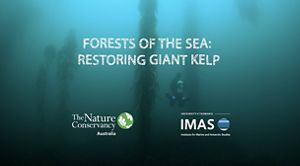
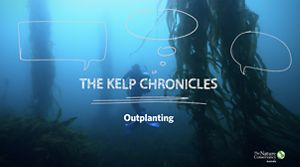
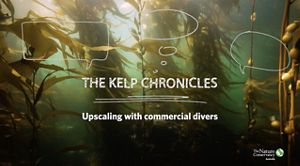
The Kelp Chronicles is a series of mini documentaries charting the innovation and collaboration that drove this transformative restoration effort.
Giant Kelp gallery


Each single step toward restoration is a ‘Giant’ leap for reforestation
This collaborative Giant Kelp forest reforestation project has been be rolled out in several phases. First, a number of sites were selected for reforestation along the east coast of Tasmania based on a variety of factors. Meanwhile, juvenile kelps were grown in local hatcheries. In 2023, a total of 16 sites underwent testing for suitability by outplanting these juvenile kelps and comparing their survival and growth across sites.
During the second phase, our efforts were focused on the most suitable sites - the 'best performing' of the trial sites were chosen for larger-scale outplanting. by commercial divers in 2024 and 2025. To date, we have had great success at several of these sites, with hundreds of giant kelps now reaching the surface after being missing for a decade.
These restored forests have been monitored and the lessons learned will be shared both nationally and globally to help inform restoration efforts in other locations where Giant Kelp has declined, including the coasts of Victoria and South Australia.
Kelp Tracker 2.0
Read more about KelpTracker 2.0 and start using it to help us find Giant Kelp forest locations: OPEN KELP TRACKER 2.0